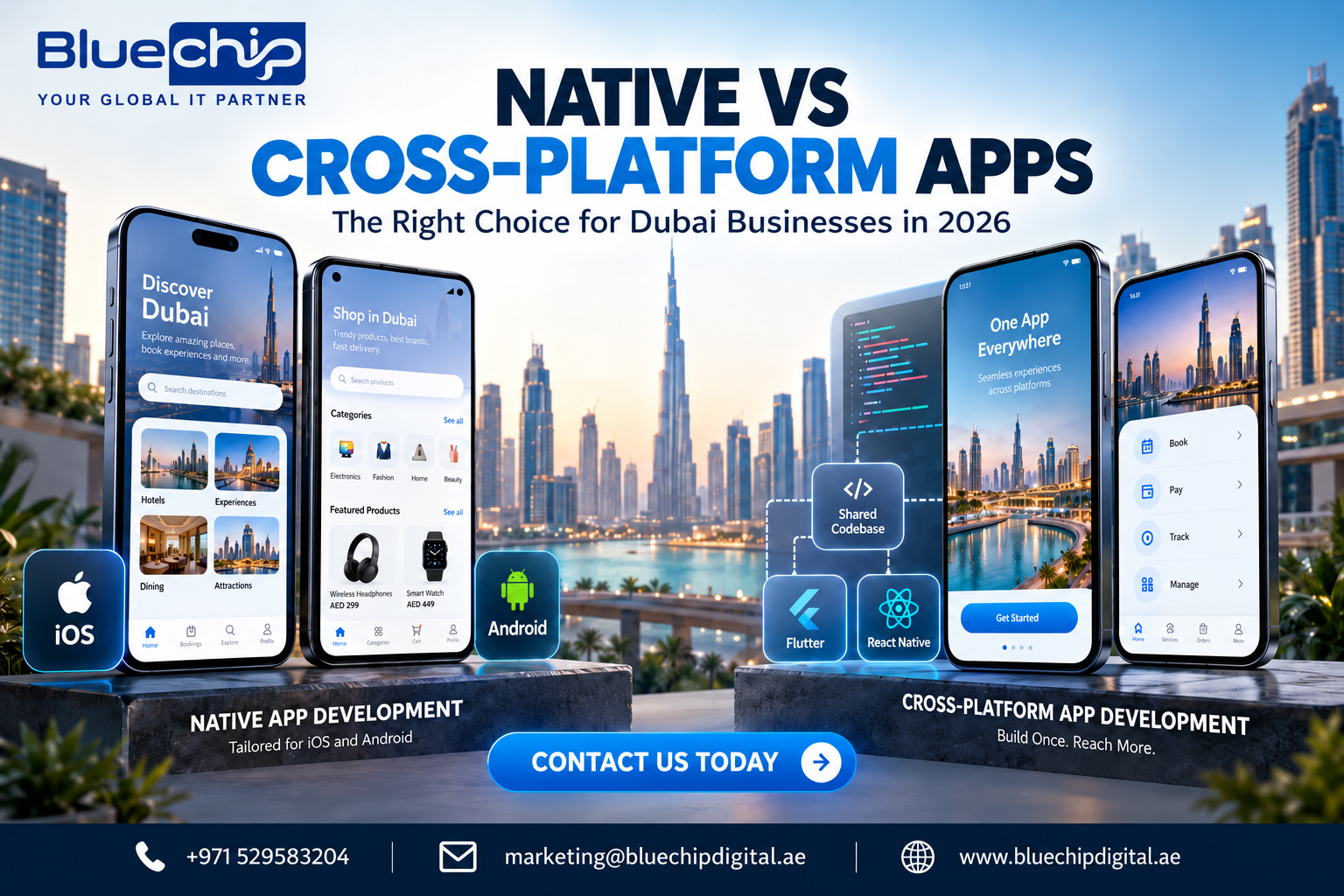
Native vs Cross-Platform App Development: What Dubai Businesses Need to Know in 2026
An incorrect approach to application development can raise costs, cause launch delays and complicate future updates. However, businesses in Dubai can benefit significantly from native and cross-platform mobile applications for online sales, bookings, payments and business operations. The question should be asked: which approach to developing mobile applications is best for businesses in Dubai?
Both approaches can yield rewarding results, but they are different in many ways.
Understanding the differences can help businesses choose the option that best suits their needs. Here’s what Dubai businesses need to know about native and cross-platform application development in 2026.
What is native app development?
This approach is used to develop an application for a particular operating system. Developers usually use programming languages Swift or SwiftUI for iOS development, while Kotlin is used for Android applications.
Since native apps are developed for a specific platform, developers can rely on unique features of the operating system where their app will run.
Benefits of native app development:
- Performance: Development of this type is beneficial if you need to use the capabilities of the iOS OS or Android.
- Device features: It becomes possible to use all the features of a particular device.
- Specific conventions: Developers can follow the conventions of a particular operating system.
- Specialized functions: This approach is great for applications that make extensive use of the camera, Bluetooth, sensors, and other features.
When is native development better?
Native development is appropriate for companies that want to take advantage of the capabilities of iOS and Android operating systems. In addition, this option may be justified for applications for which performance is critical. However, maintaining separate apps for iOS and Android may require extra effort and resources.
What is cross-platform app development?
This approach makes it possible to create one application that will be available both on iOS and Android. To do this, developers use special frameworks such as Flutter and React Native.
Creating a cross-platform app means that some of the code will be shared between iOS and Android, which reduces the amount of code that has to be maintained. It should be noted that some adjustments and tests may be required for each platform.
Benefits of cross-platform development:
- Code sharing: Developers can share much of the code between iOS and Android.
- Efficiency: It becomes possible to avoid writing some of the code for iOS and Android separately.
- Consistency: With this approach, it is possible to maintain a consistent look and feel across devices.
- Maintenance: Code changes in the core part of the application reduce the amount of code that has to be maintained.
- Extensibility: Companies that want to release applications on multiple platforms can use this approach.
- Flexibility: There are options to customize the appearance of individual components. While the fundamental elements of the interface remain the same for all devices, their appearance can vary
Flutter provides official support for developing applications for multiple platforms, and provides the ability to use platform-specific code where required.
When is cross-platform development better?
This approach is suitable for many types of business applications, from e-commerce to booking systems and field service management. In addition, cross-platform apps allow companies in Dubai to reach a wider audience. For businesses looking to provide a positive user experience while maintaining a reasonable development budget, this option is worth considering.
Native vs cross-platform app development: what is the difference?
| Factor | Native development | Cross-platform development |
| Codebase | Usually separate implementations for iOS and Android | Shared codebase for much of the application |
| Performance | Strong option for demanding, platform-specific workloads | Suitable for many business apps; performance depends on implementation |
| Development cost | Can be higher when building and maintaining both platforms | Can reduce duplicated work and overall development effort |
| User experience | Greater control over platform-specific interfaces | Can deliver consistent experiences across platforms |
| Device features | Direct access to platform APIs | Platform features may require plugins or custom native integrations |
| Maintenance | Changes may need separate implementation and testing | Many updates can be shared, though platform-specific work remains |
Neither approach is intrinsically better than the other. The choice of the approach depends on the specific needs of the business and the characteristics of the application being developed.
5 factors Dubai Businesses Should Consider in 2026
Define your goals and features
Decide what you want to achieve with your application and what functions it should have. You need to come to an agreement on what you want your application to achieve and the features that will help you accomplish your goals. A product with user accounts, a catalog of goods for sale and the ability to make payments will have completely different requirements from an application that uses intense graphics and has a lot of special features. A clear vision will help focus on the most relevant technologies rather than get caught up in trends.
Set your budget
Getting an estimate of the initial costs is important, but businesses should think about how much money will be needed for maintenance, testing, security, hosting, third-party services, and future improvements. Although developing a cross-platform application may seem like a cheaper option when you need to support multiple mobile platforms, additional costs can arise if there are problems related to custom code or complicated interactions with third-party services. To fully assess the cost of developing an application, it is important to take into account not only the cost of the development company, but also the allocation of resources for maintenance and potential changes.
Plan for Arabic, English and responsive experiences
Dubai businesses often operate in a multilingual environment, so it is important to consider how to support different languages and scripts. If the target audience of the application includes Arabic-speaking users, you need to pay attention to the nuances of the interface for users who read from right to left and perform various tests to ensure a seamless experience. It is also important to think about how the application will behave when switching between languages and scripts, for example, when displaying numbers or monetary values.
Think about integrations, security and scalability
Carefully consider what third-party services the application will interact with and what security measures are required. For example, an online trading application will require secure payment processing and interaction with external systems such as order management or delivery services. In addition, it is important to think about the scalability of the application so that it can handle an increasing number of users and additional features in the future.
Choose the right development partner
The choice of a development partner is no less important than the technology that will be used to develop the application. A qualified team will understand the strengths and weaknesses of each approach and recommend the most cost-effective solution based on the specific needs of the business. When choosing a company to develop an application in Dubai, it is important to clarify the technologies that the team uses, the security measures that will be implemented, the quality of testing, and the support and maintenance options available after the launch of the application.
Where does web application development fit in?
Not all companies need a mobile application right away. A web application allows you to provide customers with an interactive experience without requiring them to install the application from an app store. Using the example of an online trading application, a web version of the application can allow you to place an order, view your account information, and manage your data. In this case, a mobile application may be more appropriate for sending notifications about the status of an order or using special features available only on mobile devices.


